
The report contains names of entities eligible for bank licences. It was not immediately known how many applicants have been shortlisted by the high-level advisory panel.

'A repo cut will be very good for the market as it will mean that everything is being done to spur growth in these uncertain times.'

Nationalist Congress Party minister Manikrao Kokate has resigned from the Maharashtra Cabinet after a court upheld his conviction and two-year jail term in a 1995 cheating and forgery case. This marks the second NCP minister to resign this year.

The country's foreign exchange reserves declined by $7.541 billion to $572.712 billion in the week ended July 15 as the Reserve Bank continued to intervene in the market to curb the fall of the rupee. In the previous week ended July 8, the reserves shrunk by $8.06 billion to $580.25 billion, the Reserve Bank of India (RBI) data showed on Friday. On Friday, the rupee fell by 5 paise to close at 79.90 against the US dollar.
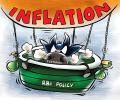
The Reserve Bank on Wednesday lowered the inflation projection for the current fiscal to 4 per cent from 4.2 per cent earlier, taking into account good agricultural output and falling crude prices.

Better protection for depositors and investors was one of the chief considerations in Union Finance Minister Nirmala Sitharaman introducing, on Friday, the Banking Laws (Amendment) Bill, 2024, in the Lok Sabha to amend four pieces of legislation. This amendment is also to improve audit quality in public-sector banks (PSBs), offer consistency in reporting by banks to the Reserve Bank of India (RBI), and provide for an increase in the tenure of directors in cooperative banks.

Recent financial crisis underscored the dangers of over-financialisation of the real economy.

Microsoft co-founder Bill Gates on Tuesday met Reserve Bank of India Governor Shaktikanta Das and discussed various issues including financial inclusion, payment systems, microfinance and digital lending among others. "Mr.@BillGates visited RBI Mumbai today and held wide ranging discussions with Governor @DasShaktikanta #RBI #rbitoday #rbigovernor #shaktikantadas #BillGates," RBI said in a tweet. Gates Foundation pursues a lot of activity in India including promotion of financial inclusion, health sector and climate change.

Reserve Bank Governor D Subbarao on Tuesday favoured bifurcation of the posts of chairman and managing director in state-run banks, saying the experience of such a split in the private sector has been satisfactory.

Reserve Bank on Wednesday cut India's growth forecast to 6.5 per cent from 6.7 per cent estimated earlier for the current financial year on account of impact of global trade and policy uncertainties. Prospects of agriculture sector remain bright on the back of healthy reservoir levels and robust crop production in 2025-26, RBI Governor Sanjay Malhotra said while unveiling the outcome of the first bi-monthly Monetary Policy Committee meeting for the current financial year.

'We never waste a crisis. There will be learning and the supervisory tools will get better with each episode.'
'Interest rates will depend on the respective banks depending upon their deposits. We will get a clearer picture from the banks in the coming days,' says Y V Reddy.

'A mule operates someone else's account to transfer illegal money.'

Concerned over the rise in mis-selling of products by banks and non-banking financial companies (NBFCs), the Reserve Bank of India (RBI) is examining whether to come up with norms to curb such practices. Observing that pushing financial products, such as insurance, indiscriminately to unaware consumers may be detrimental to their well-being, RBI Deputy Governor M Rajeshwar Rao said, "We are examining whether it necessitates framing of guidelines to address mis-selling of financial products and services by REs (regulated entities)."

Finance Minister Nirmala Sitharaman on Tuesday asked fintech firms to focus on risk management at a time when criminals are using AI to mimic voices, clone identities and create lifelike videos to manipulate people.
Take the Rediff Biz Quiz and find out how much you know about the governors of the Reserve Bank of India.

Duvvuri Subbarao recounts how his tensions with P Chidambaram and Pranab Mukherjee, then finance ministers, over monetary policy spilled over into other issues in the central bank in this excerpt from Who Moved My Interest Rate?, his memoir of his term as Reserve Bank of India governor.

A day after his appointment as the 26th governor of the Reserve Bank of India (RBI), outgoing Revenue Secretary Sanjay Malhotra on Tuesday said one must understand the economic landscape and do what was best for the economy. "Let me first go, join, understand the turf ... Here it is a different role," Malhotra said, speaking to reporters in front of North Block.
Voicing concern over the global recession, G-20 Finance Ministers have asked their central banks to adopt aggressive and unconventional monetary policies to ensure price stability and restore growth.

State Bank of India, Tech Mahindra, Larsen & Toubro, Tata Steel, Sun Pharma, Infosys, HCL Tech, Axis Bank, Tata Consultancy Services and NTPC were among the biggest laggards among Sensex shares. Nestle, Hindustan Unilever, Titan, Power Grid, UltraTech Cement and ITC were among the gainers.

The Indian services sector growth touched an 11 month high in July, supported by a pickup in new exports orders and sharp rise in overall sales, a monthly survey said on Tuesday. The seasonally adjusted HSBC India Services PMI Business Activity Index was at 60.5 in July, little-changed from 60.4 in June, and the rate of expansion was the best seen since August 2024.

As per the RBI Act, the central bank has to have four deputy governors.

Several executives argue that UPI has the potential to grow tenfold, but warn that the absence of a monetisation model risks stagnating the real-time payments system, which has been recording all-time-high transaction volumes every year.

The small finance bank model may still be testing the water some 10 years since its launch. According to banking experts, the regulator has taken a cautious approach in granting approvals. Unity Small Finance Bank was the last one to get a licence in the category in November 2021.

Gandhi was the executive director at the Reserve Bank of India before being promoted to deputy governor post.

The weakening of inflation, prospects of economic growth, geopolitical uncertainty and comfortable system liquidity may result in the Reserve Bank of India's (RBI) Monetary Policy Committee (MPC) to cut the repo rate by another 25 basis points, opine top economists. They also said the external economic pressures like trade policies and others would require continued RBI's accommodative stance and policy support for the Indian industry to sustain the growth.

All the bank notes in the denomination of Rs 20 issued by the RBI in the earlier series will continue to be legal tender, it clarified.

Reserve Bank Governor Shaktikanta Das on Friday said 67 per cent of the decline in the foreign exchange reserves since April was due to valuation changes arising from strengthening US dollar and higher American bond yields. The forex reserves, which stood at $606.475 billion as on April 2, have declined to $537.5 billion as on September 23. It was also the eighth straight week when the reserves declined.

Defending the timing of Yes Bank's moratorium, Reserve Bank of India governor Shaktikanta Das on Friday assured swift resolution to the issues concerning the beleaguered lender. "The resolution (to Yes Bank) will be done very swiftly, it will be done very fast. 30 days which we have given is the outer limit. You will see a very swift action from RBI," Das told reportters in Mumbai.

For the banking system a new cycle starts in FY2024. It's fraught with fresh challenges on asset quality and profitability, warns Tamal Bandyopadhyay.

Sanjay Malhotra takes charge as the 26th RBI governor at a time when headline retail inflation has shot up to 6.2%.

The Reserve Bank has found gaps in banks' corporate governance despite issuing guidelines on the matter, Governor Shaktikanta Das said on Monday. Addressing directors of bank boards, Das said such gaps, which have been mitigated, could have caused "some degree of volatility". He also hit out strongly against "smart accounting" to conceal stress and bloat financial performance.

At a time when the role of corporate boards is once again under the scanner, independent directors on the Paytm Payments Bank board have indicated that red flags were raised over regulatory issues but they may have been late in doing so. "As independent directors, we asked questions and monitored responses to the Reserve Bank of India (RBI). Many changes were made on compliances. "Obviously, in retrospect, it was not found to be enough," said one of the independent directors on the condition of anonymity.

Reliance Industries' refining earnings will remain steady, supported by its position as India's largest importer of Russian crude and favourable global supplies, according to analysts at JM Financial and Goldman Sachs. Reliance imported more Russian barrels than any other Indian refiner in the past eight months, according to data from Bloomberg/Kpler.

The Union finance ministry will meet CEOs of public sector banks to discuss issues related to cybersecurity in the wake of the Rs 820 crore (Rs 8.2 billion) fraud that hit Kolkata-based UCO Bank last month.
Reserve Bank Governor Bimal Jalan on Monday held a meeting the bankmen's unions in order to address the problems faced by the bank employees in issuing clean currency notes to the public.

Commercial banks have turned cautious in lending to smaller microfinance institutions (MFIs), which has compelled the latter to borrow from non-banking financial companies (NBFCs) at much higher rates. Recently Reserve Bank of India (RBI) Deputy Governor M Rajeshwar Rao slammed micro lenders for increasing their margins "disproportionately" and said these lenders were quick to pass on the increased cost to the borrowers but reluctant to pass on the benefits under the new regime, where margins are not capped.

The governor made it clear that the RBI is aware of what's happening and acts accordingly, but doesn't make a noise about that, points out Tamal Bandyopadhyay.

Last fortnight, State Bank of India Chairman C S Setty lifted the veil on a subject long spoken of in corporate corridors: Why can't our banks finance mergers and acquisitions (M&As)? Change is in the air: Indian Banks' Association (of which Setty is the chairman) is to "make a formal request" to Mint Road to make way for it. Thus far the exclusive turf of foreign banks even though its funding remains offshore - as in, it's not on these entities rupee-book (and a few select shadow banks) - a most lucrative segment in the investment banking suite, M&As, will be homeward-bound.
